Our mission
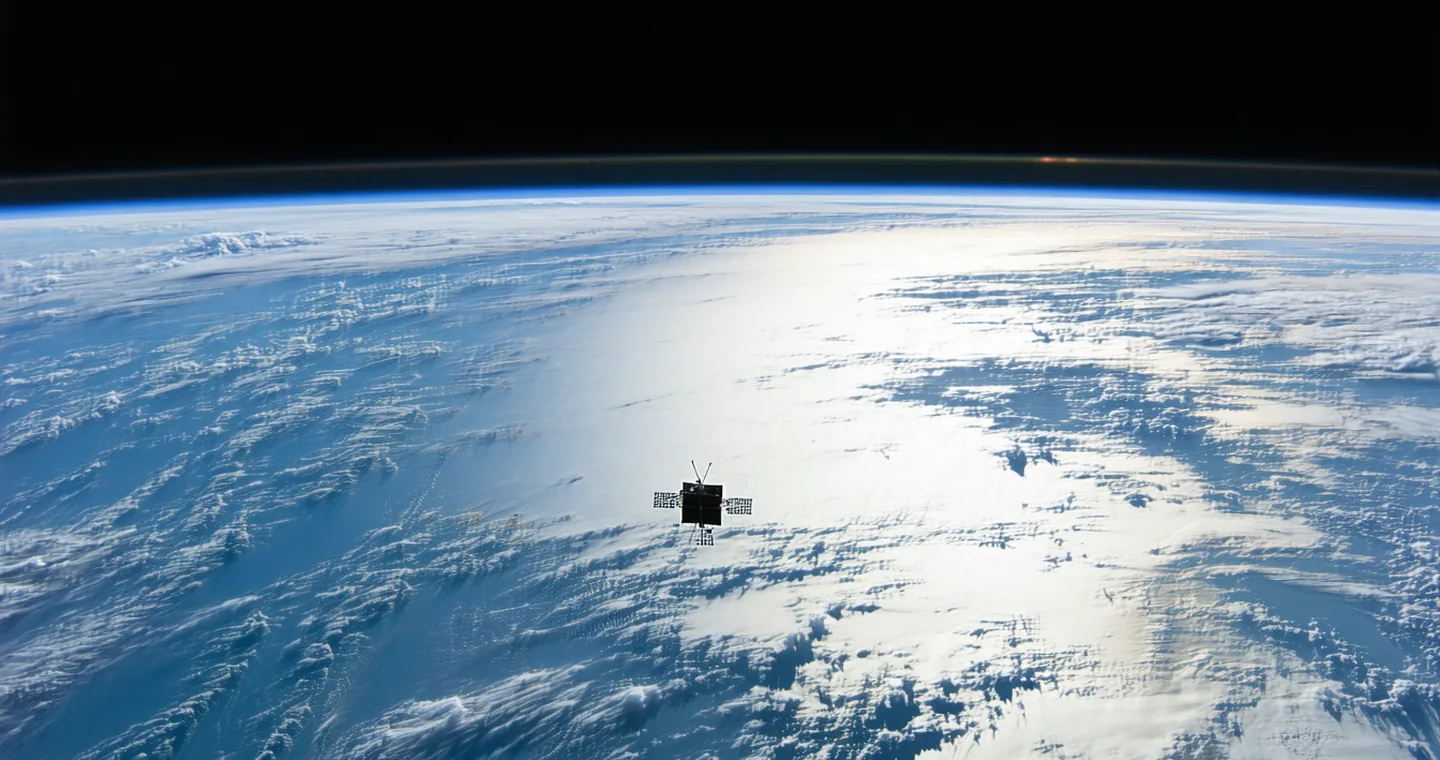
We're making the satellite a computer,
We're making the satellite a computer,
not a camera.
The best sensor in the world doesn't matter if the intelligence it generates arrives too late to act on.
The best sensor in the world doesn't matter if the intelligence it generates arrives too late to act on.
Every satellite mission has the same structural problem: the sensor collects far more data than the communication link can carry to the ground. The gap between sensor capability and data delivery has widened steadily as resolution and revisit rates have improved. The ground link has not kept pace.
The result is a 12–24 hour gap between the moment a satellite observes something meaningful and the moment an analyst can act on it. For most applications — wildfire monitoring, maritime domain awareness, disaster response, agricultural observation — that gap erases the value of the observation entirely.
The industry response has been to build more ground stations, compress data harder, and prioritize which imagery gets downlinked. None of these address the root cause: the satellite is a passive sensor, not an active processor. It collects. It stores. It waits.
TILE changes the architecture. Move the compute to the sensor. Process in orbit. Downlink intelligence, not data.
The vision is a constellation where edge compute is a standard component — as expected as an attitude control system or a comms antenna. Where every satellite, regardless of application, can run inference against its own sensor data before it asks the ground for help.
That world produces data products that don't exist today. Real-time change detection at global scale. Anomaly alerts within seconds of observation. Sensor fusion across distributed constellation nodes. The economics of satellite data shift when the bottleneck is removed.
TILE hardware revision reaches AIT-ready status. First operator integration programs underway. Inference performance and radiation reliability validated in ground and thermal-vacuum testing. Operator toolchain for model compilation, pre-launch loading, and on-orbit result retrieval in pre-release.
TILE generation 2 with higher INT8 inference throughput and ground-uplink model update capability via the satellite's existing command link. Constellation-scale deployments enabling cross-pass sensor fusion and distributed anomaly correlation across multiple orbital planes.
On-orbit compute treated as a standard bus subsystem — specified in the satellite PDR alongside the EPS, attitude control, and S-band radio. A generation of satellite data products that can only exist when the inference runs at the sensor, not after a 12-hour ground pipeline: real-time maritime domain awareness, sub-orbit wildfire alerts, persistent infrastructure change monitoring at constellation cadence.
If you are designing a satellite mission — 6U CubeSat, smallsat, or larger — and your downlink budget is already a constraint at the design stage, we want to hear about the architecture.