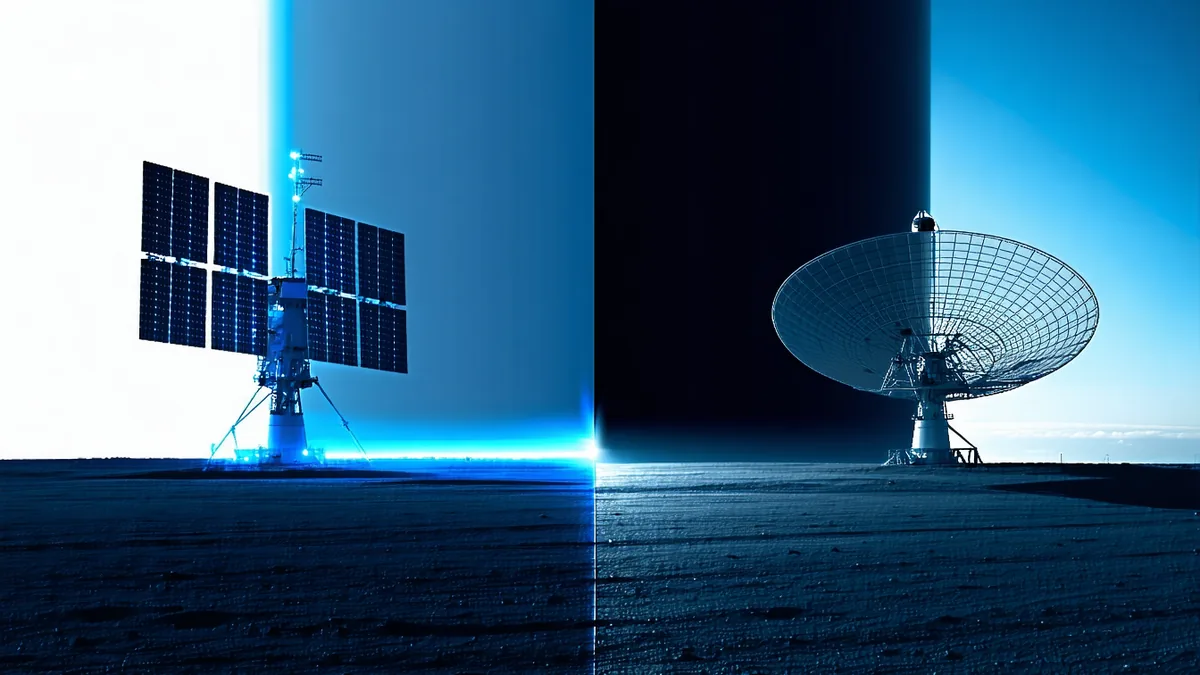
Ground pass windows are one of the most precisely understood parameters in satellite operations. Operators know them by heart — when their bird will crest above a particular ground station's horizon mask, how many degrees of elevation they'll get, how many minutes they have before the link margin drops out. What gets less attention is the question on the other side of that pass: what happened in the hours before it?
For time-critical applications, the answer to that question is often "we don't know yet." The satellite collected data. The satellite stored it. The satellite waited. And when the window finally opened, it began transmitting — and somewhere downstream, an analyst or an automated system started working on imagery that was, by then, already old.
The Anatomy of Orbit-to-Decision Latency
For a satellite in a typical sun-synchronous low Earth orbit at roughly 500 km altitude, ground pass frequency at any given mid-latitude station is in the range of two to four passes per day, each lasting between five and twelve minutes depending on elevation angle and station placement. Polar ground stations can improve this geometry substantially, which is why Svalbard has become critical infrastructure for civilian EO operators. But even with polar augmentation, the interval between data collection and data downlink is measured in hours, not minutes.
Latency in satellite data pipelines is not just the physics of orbital mechanics. It compounds. After the downlink window closes, there's the time to transfer raw data from the ground station receive facility into processing infrastructure — often cloud-hosted, sometimes on a commercial ground station network's own compute. Then preprocessing: radiometric correction, orthorectification, cloud masking. Then the actual analysis pipeline: whatever model or detection algorithm the operator cares about. Then delivery of the output to the end consumer. An end-to-end orbit-to-analyst latency of four to eight hours is common in production EO pipelines today, even with modern cloud processing infrastructure.
When Hours Are Mission-Critical
For most satellite data use cases, four-to-eight hours is acceptable. Crop monitoring, infrastructure mapping, long-term deforestation tracking — the change you're measuring happens over days or weeks. The latency is noise.
But consider a scenario where a constellation operator is tasked with monitoring a specific industrial port facility for vessel activity and cargo movement. The window between a vessel's arrival and departure might be six to twelve hours. If the first satellite pass over the site happens to produce cloudy imagery — unusable — and the next usable pass is twelve hours later, the useful observation window may already be closed by the time analysis is complete. The satellite had the data. The latency ate the value.
This is not a contrived edge case. Disaster response imaging faces the same problem: a flood event or wildfire evolves on hour-to-hour timescales, but the first actionable EO product reaching emergency managers is often delivered after the peak of the crisis has already passed. Defense applications are more acute still — asset cueing that arrives after a target has relocated is not cueing, it's history.
Orbit-to-Decision vs. Orbit-to-Downlink
The standard framing is orbit-to-downlink latency, which is the time from data collection to data reaching a ground system. This is where most optimization effort has been directed — additional ground stations, inter-satellite links, low-latency commercial ground station networks. These are real improvements and they matter. But they address only one leg of the problem.
We're not saying reduced downlink latency is the wrong goal. We're saying it addresses the wrong bottleneck for time-critical applications. The more meaningful metric is orbit-to-decision latency: the time from collection to actionable output. Compressing the downlink window from six hours to two hours doesn't help if the processing and analysis pipeline still takes four hours after that.
The only place where orbit-to-decision latency can be fundamentally compressed — not just incrementally improved — is onboard the satellite itself. If classification, detection, or fusion runs at sensor rate, in orbit, then the output that arrives at the ground station is not raw data waiting to be processed. It's an answer. The latency drops from hours to minutes: the time to the next downlink window, but with the processing already complete.
The SWaP Constraint Is Real
This is the point where honest discussion of in-orbit compute has to acknowledge the physical constraints. Processors capable of running neural network inference at useful throughput are power-hungry by satellite standards. A modern EO satellite bus allocated perhaps 10–20 W to its primary compute payload — enough for housekeeping, attitude control, and basic data formatting. Adding an edge inference processor changes the power budget arithmetic, and on a small satellite where the total power envelope is already tight, that's not a trivial addition.
This is why the design philosophy for orbit-native compute has to be different from terrestrial edge compute. The question isn't "how do we put a GPU in a satellite?" It's "what is the minimum compute required to run a useful inference task within a constrained SWaP envelope?" The answer involves quantized models, fixed-point arithmetic, careful memory management, and hardware designed from the ground up with orbital power budgets as a primary constraint rather than an afterthought.
Latency as a Mission Architecture Decision
The satellite missions being designed today — many of which will launch two to four years from now — are being architected with assumptions about data pipeline latency that may no longer hold by their operational dates. As in-orbit compute hardware matures and the cost of onboard processing comes down relative to ground segment costs, the baseline assumption of "collect everything, downlink everything, process on the ground" will increasingly be revisited.
Operators designing missions today should be asking: which of our intended use cases are genuinely latency-tolerant, and which ones have been quietly accepting multi-hour latency because there was no alternative? The distinction matters for architecture decisions made now. A satellite designed with no onboard processing capability is locked into ground-centric latency for its entire mission life — typically five to seven years for LEO smallsats. That's a long time to live with a bottleneck that the industry is actively working to solve.
The hidden cost of latency is not just missed observations. It's the compounding of every hour of delay against the value-decay curve of time-sensitive intelligence. The operators who will get the most from their constellations over the next decade are the ones who start treating latency not as an environmental given, but as an engineering parameter — one that can be changed by moving compute closer to where the data is created.